Let me count the ways

Anna VanDelman reports:

Our meeting of May 21, 2014 was brought to you by the Count of Sefirot (further apologies to Sesame Street).

Our guest presenter was Laya Crust. A native of Winnipeg, this mother of six currently resides in Toronto. Laya has studied with world renowned artists and calligraphers in fields such as drawing, painting and printmaking. In addition she has engaged in Jewish studies in Manitoba, Toronto and Jerusalem. While she continues to work in a variety of media (fabric, glass, clay and silver) much of Laya’s current work is with paint and inks on paper.
From her artist’s statement: “Whether working on a ketubah, painting designs for a 5’x 6’ window, interpreting a story from the Bible or designing a fundraising piece, I work to uncover the essence of the message. In that way I can talk to the soul of the viewer.” Laya’s work is truly a celebration of what life has to offer us. A current piece of note is a Megillat Esther, wherein the ten sons of Haman (yimach shemo) are depicted as evil world leaders throughout history. This and other of her works are in private collections around the world.

Laya is no stranger to our Guild. She did a memorable presentation for us on calligraphy 23 years ago that remains fresh in the minds of those who attended it. Chaya Erez introduced Laya Crust and the current programme based on counting. How do we love our holidays? Let us count the ways: “And you shall count unto you from the morrow after the day of rest, 7 weeks/49 days the fiftieth day being Shavuot”. We count the days from the second day of Passover to the forty-ninth day, Shavuot, when we became a nation receiving the Ten Commandments, our constitutional charter.

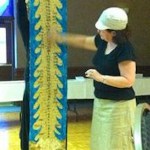
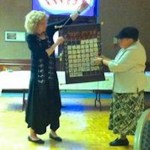
To help us count the days between Pesach and Shavuot we can use an omer counter. Omer means measurement. We measure an omer of barley, the Shavuot grain offering in the temple. We use attributes of the Sefirot to make ourselves better, rising from a state of impurity to a state of heightened consciousness. These days are also connected to a time of mourning for Rabbi Akiva’s 24,000 students who died of the plague. No celebrations are permitted until the thirty-third day when the plague stopped. Lag B’omer is a day celebrated with bonfires and the mourning period resumes until Shavuot. Laya took us on a visual power point trip with a showcase of exquisite counters from around the world to inspire us. She also brought real counters to show us, including one adapted from an advent calendar. Pomegranate Guild members, Elaine Genesove and Paula Miller showed their own beautiful omer counters and then members engaged in the process of creating omer counters with samples prepared by Laya and assisted by her husband (thank you!). Guild member, Chaya Erez thanked Laya for helping us turn the ordinary into the extraordinary. Truly, an evening of magic! Thank you Laya for allowing us a glimpse into the phenomenal creativity of your artist mind.

Listen!

Anna VanDelman reports

Our April 2014 meeting was brought to you by Judith Leitner – Director of Visual Arts and a founder of The Toronto Heschel School – and by the letter Shin “ ש” (with apologies to Sesame Street).
Judith teaches in an arts-based integrated curriculum with a strong environmental ethos impelled by ethical behaviour. She develops the visual arts programme and wrote a Judaic Arts Compendium (see http://www.torontoheschel.org).
Judith led us through a series of activities that helped us see how letters can be expressive. What does the word Sh’ma “שמע” mean? The letter form has three branches. The dot makes it a ‘shin’ or a sin, depending on its placement. Are the three arms of the letter equal or not? What happens when we change their size? We looked at the essential elements of design: Line, shape, direction, size, and texture. We used big arm gesture drawing to create a “shameless Shin”. Is it straight? Lying down? Upside down? And then we made a “shy shin.” Is it small? Is it hiding? We continued with more variations on the theme of “Shin” (for example, “Shin” in shock).
And then we were invited to think about our personal connection to the “Shin.” We shared feelings about the letter, most of us relating to the Sh’ma and other words that begin with the same sound, “Sh”. As texture plays an important role in art, we concluded the evening by selecting or designing a “Shin” and interpreting it in textiles. President Karen Chisvin thanked our guest for leading us in an interesting workshop that opened a new window of discovery on a Jewish theme.


Guild Members’ work on view at the ROM

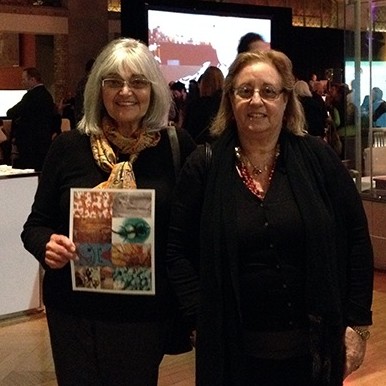
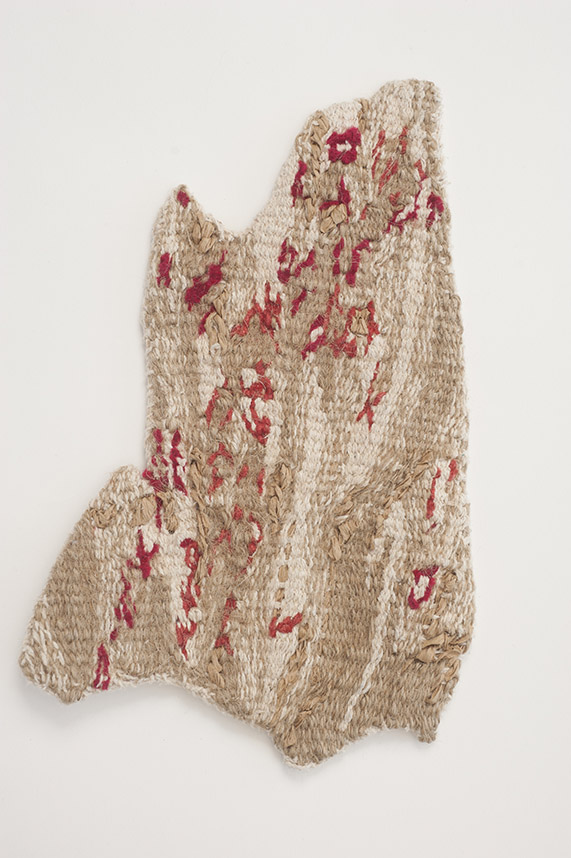
Arlette and JuanaJuana Sleizer and Arlette Shulman have work on view at the ROM for the museum’s centennial year. The opening ceremony and party were on March 19th, and members can continue to see the work when visiting the ROM until March 29, 2015. The exhibit is located in the Canada Court Level 1.


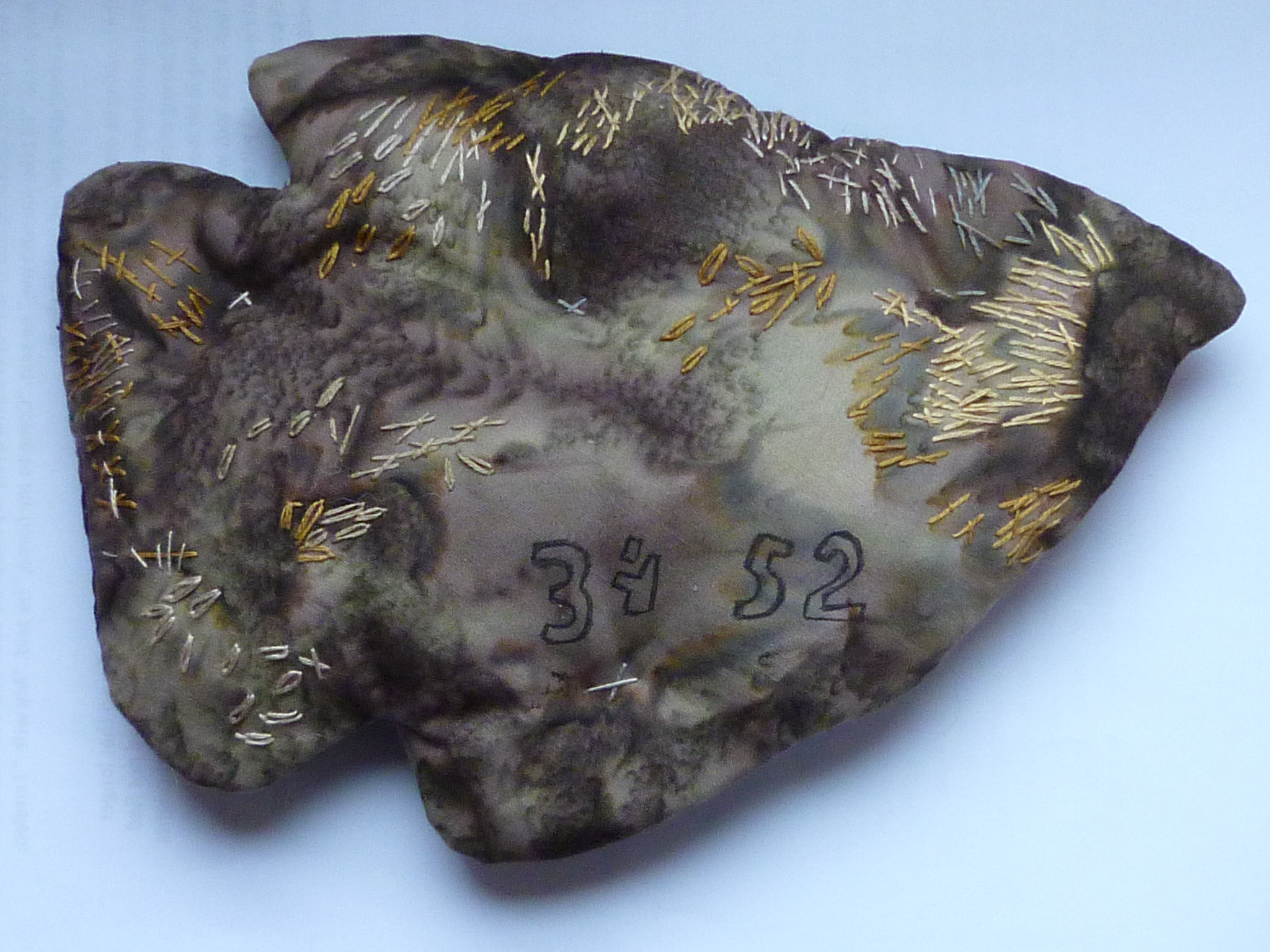
Oracle boneJuana’s work, Oracle Bone is a small format tapestry reproducing an ancient artifact. Arlette’s work is an interpretation of an arrowhead, reputed to be the oldest in the ROM collection.arrowhead

For more information, as well as great pictures and stories about all of the 78 submissions, see ROM100. Click each picture to reveal the artist and artist’s statement.

Congratulations Juana and Arlette on your participation in this exciting, celebratory exhibit!

Torah Stitch by Stitch: 9 months later

Anna VanDelman reports:

Our March meeting was a wonderful overview of the Torah Stitch by Stitch project, and its status to date. Honey Mitchell introduced our presenter, Temma Gentles, founding member of the Guild and award-winning textile artist.

Kristina - panel detail

Kristina – panel detail

Temma explained her unique project “Torah Stitch by Stitch”, a call to action by the morning prayer, “Awake to the Torah”. The project currently has over 700 volunteer stitchers involved from all around the world, including  Guatamala, Zimbabwe and Viet Nam.

For Temma the project began to form conceptually when she and her husband Paul were in Israel on sabbatical at Ein Hod. She was inspired by the work of a number of Orthodox Jewish artists. Temma shared a sampling of this work with us, including the paper-cut work of artist Jacqueline Nicholls which uses traditional art forms to show the anger of women who are not able to participate in religious activities. We also saw a kittel for a woman – usually a man’s garment – which resembled a straight-jacket. Artist Andi Arnowitz used a variety of artistic media to express ironic and angry messages and included a coat for an agunah made of cut up Ketubot and worry beads the size of baseballs.

A self-described “fontophiliac,” Temma then gave examples of her letter-form inspirations. She showed fonts from Ben Shahn‘s book, The Alphabet of Creation, explained the sofer’s guidelines of STAM: Sefer Torah, Tefillin, mezuzah. She shared the work of amazing calligrapher and sofer stam Izzy Pludwinski in his book Mastering Hebrew Calligraphy and his contributions to the Saint Johns Bible (SaintJohnsbible.org).

Kristina detail 2

Kristina detail 2

Temma showed us sources for cross-stitching text and for large collective projects. We saw samplers cross-stitched onto aida cloth which were used to teach very young girls and women to sew and to read. These young women then went on to stitch quotations and family genealogies, which then became family records.The Quilt of Belonging had its inaugural exhibition in 2005. Assembled it is 36 m long and includes representation from 263 nationalities in Canada.

All of these influences have contributed to the project that will see the Torah cross-stitched in 4-verse segments by 1463 stitchers. It will far exceed 36 m! Each stitcher who registers receives a kit with the base square of aida cloth, black embroidery floss with pointers about stitching, and the stitcher’s four verses graphed as a guideline.

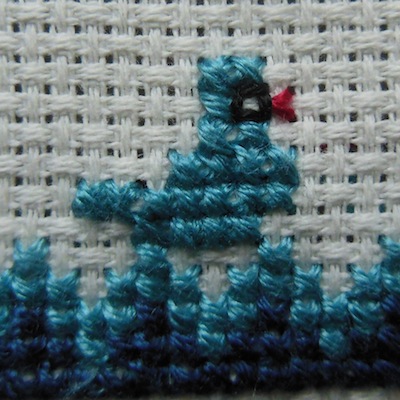
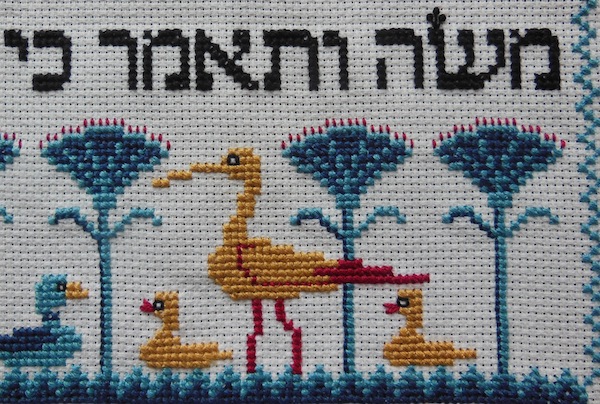
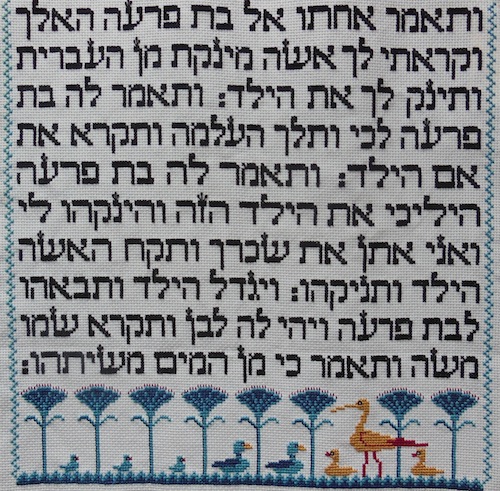
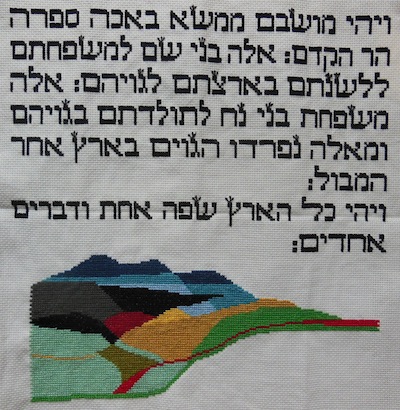
Temma showed completed pieces by a number of participants along with comments about the work. She pointed out that nearly every stitcher has a personal story that emerged from participating in the project. Then Guild members Brenda Conway and Kristina Landstrom-Jaffe showed their newly submitted panels (not yet proof-read or blocked), and Karen Chisvin showed her completed log. Brenda’s panel embellishment is a cross-stitched representation of one of her husband’s – artist Jerry Conway – landscape paintings. Kristina’s was an interpretation of the discovery of Moses in the bulrushes using Egyptian inspired motifs for papyrus and holy water birds.

Kristina - panel

Kristina – panel

Temma concluded with the exhibit concept by stage designer Philip Silver. It will literally be a walk through the Torah. The completed Torah will be 8 feet high and as long as a football field containing 1463 portions. It will be configured for viewers to walk into, along, and out of the assembled piece. The scope of the project is just emerging. At this point in time the grant request process is about to begin and more organizational infrastructure put into place.

Brenda's panel

Brenda – panel

President Karen Chisvin thanked Temma for this unique and amazing presentation. We all wished Temma a “Yascher Kochechah” on her work with this project: “Temma we are used to your doing innovative and unbelievable projects.  This will be your crowning glory. So keep on jumping Temma, jump higher and higher. We all hope you grow wings before you hit the ground and may you continue to share your unique and awesome talent with the entire world well into the future.”

All images courtesy of artists and Torah Stitch by Stitch project


Dress Codes: Revealing the Jewish Wardrobe

Dress Codes at the Israel Museum is “a new Israel Museum exhibit [that] explores the roots of fashion in Jewish traditional clothing around the world from the 18th through the 20th centuries. Click the link for a sampling of the riches on view – we can’t copy the pictures for you. The exhibit is open until October 25, so for members travelling to Israel, put this on your “must see” list! Thank you, Paula, for bringing this to our attention.

Fabulous Felting Fun in February

rainbow fleeceAnna reports: With illness overtaking our scheduled guest artist, our own Melanie Siegel, artist and Exhibits Chairperson, stepped in on a moment’s notice to provide an exciting programme for the evening. And what fun it was!

Melanie introduced us to a technique of felting bracelets and then demonstrated the process. She created a basic form with neutral fleece, by wrapping it around her hand and securing the wrap with wool yarn. Then, layers and layers of exotic colours of our choice wrapped round and round the form.

All members got busy immediately, wrapping and wrapping and wrapping. Then we dipped our hands in water and mild soap. We rolled the bracelet between our hands, feeling it firm up as the felting process proceeded. What quick workers Guild members are: in an hour we completed what is often a 3-hour process. We set our bracelets aside to dry and imagined the embellishment we might later do with beading.

Once the drying started, Melanie also taught us how to felt beads out of the fleece wool. Then, by rolling the fleece in a bamboo mat, she demonstrated how we could make snake-like shapes –  to add a Rastafarian look to our hairdos? Finally, Melanie shared with us her love of her new felting machine.

How lucky we are to have such a talented, creative and imaginative member as Melanie in our group! She is truly a Pomegranate treasure. Thank you, Mel.

“Colour and Texture are my Inspiration”

Juana_Sleizer_library-150x185The work of Guild member Juana Sleizer, Textures – Tapestry Exhibition, is being featured for the entire month of March at Mimico Centennial Library.

This is the third year that Juana’s work has been selected by the Toronto Public Library for exhibition in one of its branches.

The library is located at  47 Station Road, Toronto, M8V 2R1. The closest major intersection is Lake Shore Blvd. West and Royal York Road. The library is located on southeast corner of Stanley Street and Station Road.  

TPL Announcement
Mimico Centennial Branch Information

Juana Sleizer invites all Guild members to come and visit the exhibition. She does remind us that this exhibition is hung in the mezzanine area of the library and there is no elevator at this site.

http://tapestryworld.blogspot.ca/